
英语原文共 4 页,剩余内容已隐藏,支付完成后下载完整资料
Reinforced Concrete Rises: The Ingalls Building
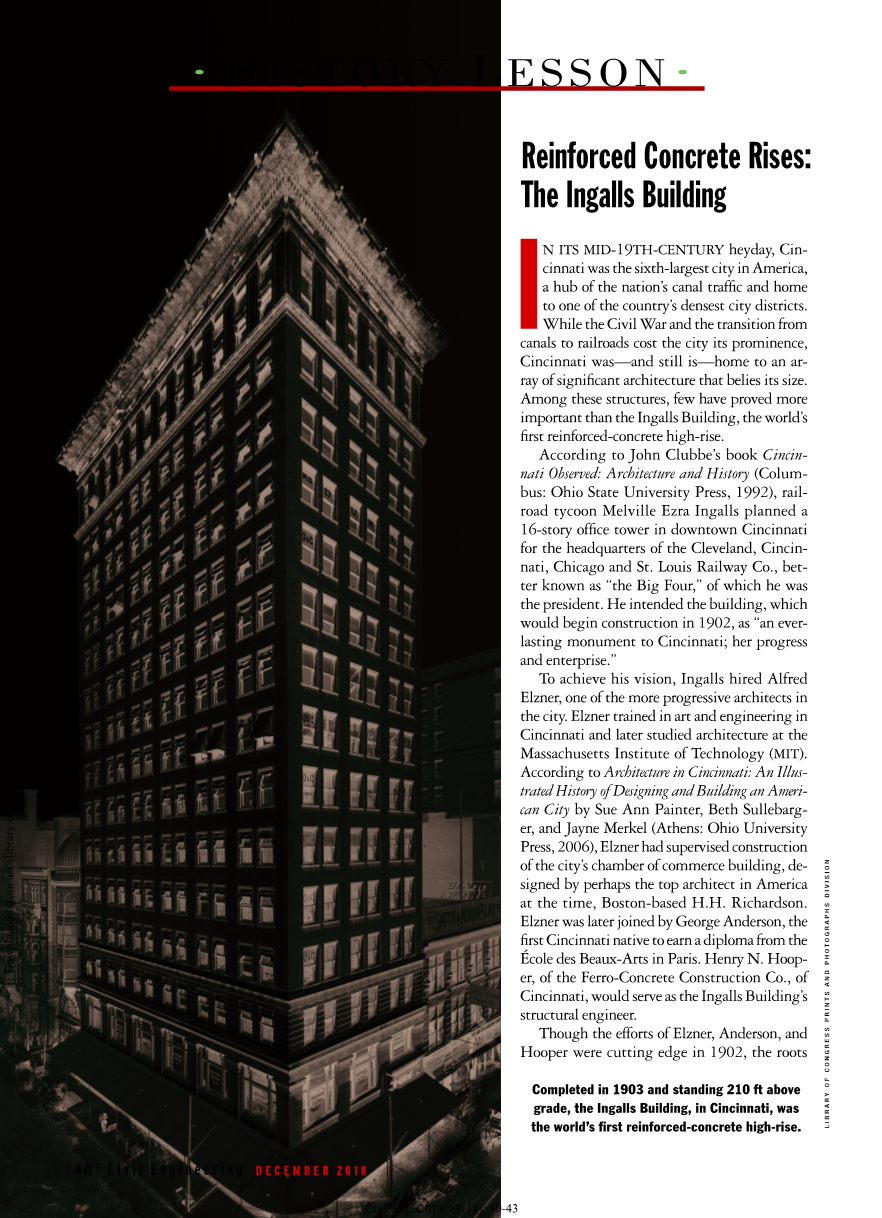
In its mid-19th-century heyday, Cincinnati was the sixth-largest city in America, a hub of the nationrsquo;s canal traffic and home to one of the countryrsquo;s densest city districts. While the Civil War and the transition from canals to railroads cost the city its prominence, Cincinnati was—and still is—home to an array of significant architecture that belies its size. Among these structures, few have proved more important than the Ingalls Building, the worldrsquo;s first reinforced-concrete high-rise.
According to John Clubbersquo;s book Cincinnati Observed: Architecture and History (Columbus: Ohio State University Press, 1992), railroad tycoon Melville Ezra Ingalls planned a 16-story office tower in downtown Cincinnati for the headquarters of the Cleveland, Cincinnati, Chicago and St. Louis Railway Co., better known as “the Big Four,” of which he was the president. He intended the building, which would begin construction in 1902, as “an everlasting monument to Cincinnati; her progress and enterprise.”To achieve his vision, Ingalls hired Alfred Elzner, one of the more progressive architects in the city. Elzner trained in art and engineering in Cincinnati and later studied architecture at the Massachusetts Institute of Technology (MIT). According to Architecture in Cincinnati: An Illustrated History of Designing and Building an American City by Sue Ann Painter, Beth Sullebarger, and Jayne Merkel (Athens: Ohio University Press, 2006), Elzner had supervised construction of the cityrsquo;s chamber of commerce building, designed by perhaps the top architect in America at the time, Boston-based H.H. Richardson. Elzner was later joined by George Anderson, the first Cincinnati native to earn a diploma from the Eacute;cole des Beaux-Arts in Paris. Henry N. Hooper, of the Ferro-Concrete Construction Co., of Cincinnati, would serve as the Ingalls Buildingrsquo;s structural engineer.
Though the efforts of Elzner, Anderson, and Hooper were cutting edge in 1902, the roots of reinforced-concrete construction date as far back as the 17th century, when iron tie rods and armatures were used to strengthen masonry, according to historian Carl W. Condit, in his journal article “The First ReinforcedConcrete Skyscraper: The Ingalls Building in Cincinnati and Its Place in Structural History” (Technology and Culture, Vol. 9, No. 1, January 1968, pp. 1–33).
But the contemporary use of reinforced concrete only accelerated in the middle of the 19th century, as engineers, builders, and inventors sought a way to reinforce concrete with metal to, Condit wrote, “secure a property thought to be lacking in the material itself.”
By the 1870s, many builders were exploring the use of reinforced concrete. William E. Ward built a home in New York state near the Connecticut border that “proved to be the first complete work of reinforced-concrete construction,” Condit wrote. Ward himself explained that the impetus of the idea struck him in 1867, when he noticed “the difficulties of some laborers on a quay trying to remove cement from their tools. The adhesion of the cement to the iron was so firm that the cleavage generally appeared in the cement rather than between the cement and the iron.”
While conducting experiments early in the homersquo;s construction, Ward discovered that “the utility of both iron and beacute;ton [concrete] could be greatly increased for building purposes through a properly adjusted combination of their special physical properties.”
There were other innovations along the way, Condit wrote. American inventor Thaddeus Hyatt studied the behavior of reinforced concrete in 1877 and concluded that “the coefficients of thermal expansion of iron and concrete are nearly identical and that the elongation of the two under load is virtually the same for the two materials.”
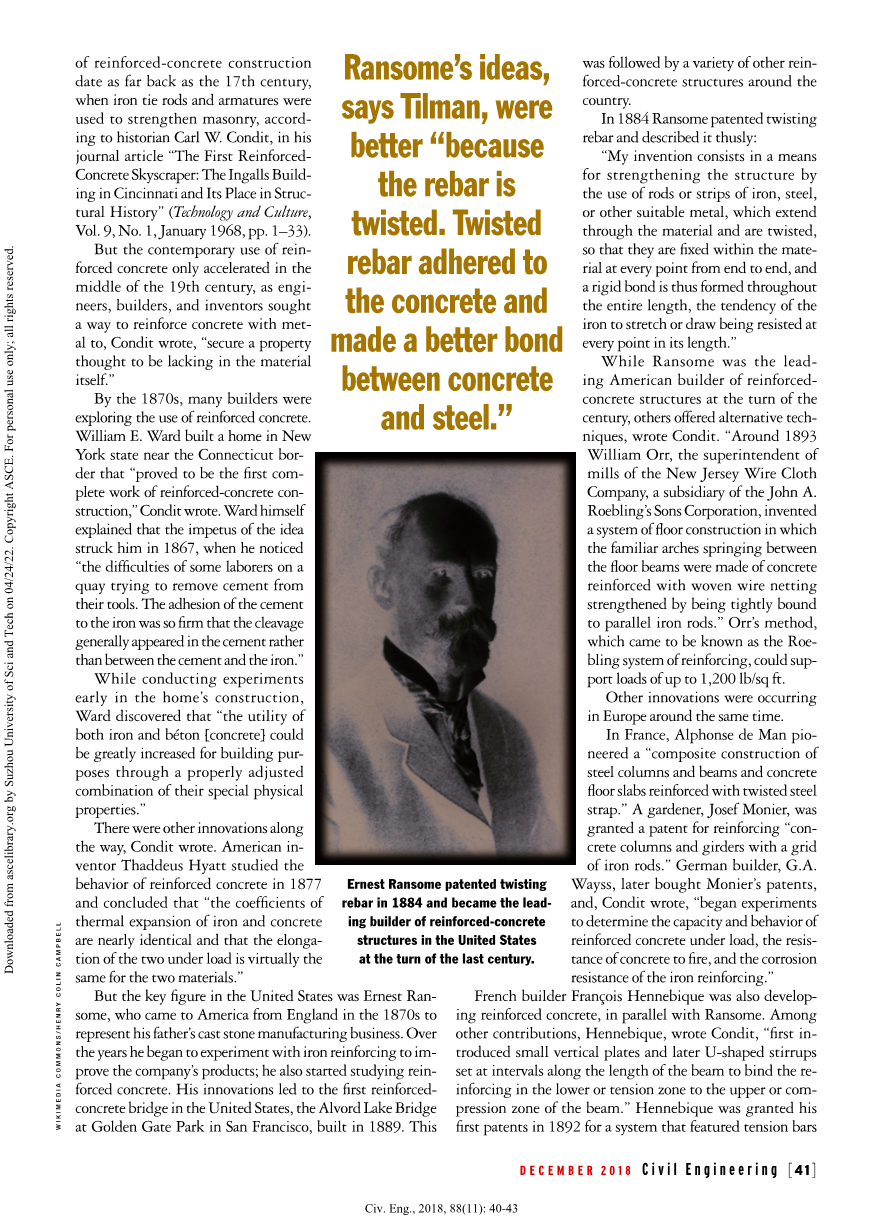
But the key figure in the United States was Ernest Ransome, who came to America from England in the 1870s to represent his fatherrsquo;s cast stone manufacturing business. Over the years he began to experiment with iron reinforcing to improve the companyrsquo;s products; he also started studying reinforced concrete. His innovations led to the first reinforcedconcrete bridge in the United States, the Alvord Lake Bridge at Golden Gate Park in San Francisco, built in 1889. This was followed by a variety of other reinforced-concrete structures around the country.
In 1884 Ransome patented twisting rebar and described it thusly: “My invention consists in a means for strengthening the structure by the use of rods or strips of iron, steel, or other suitable metal, which extend through the material and are twisted, so that they are fixed within the material at every point from end to end, and a rigid bond is thus formed throughout the entire length, the tendency of the iron to stretch or draw being resisted at every point in its length.”
While Ransome was the leading American builder of reinforcedconcrete structures at the turn of the century, others offered alternative techniques, wrote Condit. “Around 1893 William Orr, the superintendent of mills of the New Jersey Wire Cloth Company, a subsidiary of the John A. Roeblingrsquo;s Sons Corporation, invented a system of floor construction in which the familiar arches springing between the floor beams were made of concrete reinforced with woven wire netting strengthened by being tightly bound to parallel iron rods.” Orrrsquo;s method, which came to be known as the Roebling system of reinforcing, could support loads of up to 1,200 lb/sq ft.
Other innovations were occurring in Europe around the same time.
In France, Alphonse de Man pioneered a “composite construction of steel columns and beams and concrete floor slabs reinforced with twisted steel strap.” A gardener, Josef Monier, was granted a patent for reinforcing “concrete columns and girders with a grid of iron rods.” German builder, G.A. Wayss, later bought Monierrsquo;s patents, and, Condit wrote, “beg
剩余内容已隐藏,支付完成后下载完整资料
资料编号:[588697],资料为PDF文档或Word文档,PDF文档可免费转换为Word
您可能感兴趣的文章
- 饮用水微生物群:一个全面的时空研究,以监测巴黎供水系统的水质外文翻译资料
- 步进电机控制和摩擦模型对复杂机械系统精确定位的影响外文翻译资料
- 具有温湿度控制的开式阴极PEM燃料电池性能的提升外文翻译资料
- 警报定时系统对驾驶员行为的影响:调查驾驶员信任的差异以及根据警报定时对警报的响应外文翻译资料
- 门禁系统的零知识认证解决方案外文翻译资料
- 车辆废气及室外环境中悬浮微粒中有机磷的含量—-个案研究外文翻译资料
- ZigBee协议对城市风力涡轮机的无线监控: 支持应用软件和传感器模块外文翻译资料
- ZigBee系统在医疗保健中提供位置信息和传感器数据传输的方案外文翻译资料
- 基于PLC的模糊控制器在污水处理系统中的应用外文翻译资料
- 光伏并联最大功率点跟踪系统独立应用程序外文翻译资料